Baby Back vs. Spare Ribs: Pick a Side
Two racks walk into a smoker. Only one walks out the way you hoped.
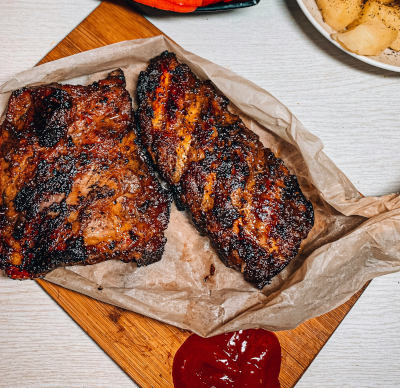
Right: baby backs.
Same animal. Very different smoke.
In the world of pork ribs, there is no Switzerland. You are either a baby back person or a spare rib person, and while we respect both parties (mostly), we'd like to help you understand what you're getting into before you commit. Because nothing is worse than showing up to a twelve-hour smoke with the wrong rack of ribs and a head full of misplaced confidence.
Let's settle this the right way. No politics. No flag-planting. Just meat, science, and a healthy dose of opinion. (You knew the opinion was coming.)
First, Where Do These Things Actually Come From?
A pig, obviously. But let's be more specific.
Baby back ribs — also called loin back ribs — come from the upper part of the rib cage, where the ribs meet the spine. They're called "baby" not because they come from a young pig, but because they're shorter than spare ribs. The loin muscle runs along this section, and since that muscle doesn't do a lot of heavy lifting, baby backs tend to be leaner and more tender by default. They curve more, they're shorter, and they'll make you pay for all of the above at the grocery store.
Spare ribs come from the belly side of the rib cage — lower down, closer to where you'd find bacon country. (That alone should tell you something.) They're flatter, longer, and have significantly more fat and connective tissue running through them. St. Louis-style spare ribs are simply spare ribs with the sternum, cartilage, and the flap of meat trimmed away to make a neater rectangle. Same rib, tidier package.
So in the simplest terms: baby backs are up top, spare ribs are down low. The pig has spoken.
The Case for Baby Back Ribs
Baby backs have a few things going for them, and they are not shy about it.
They're leaner, which means they cook faster. We're talking 4 to 5 hours at your low-and-slow 225–250°F range, versus 5 to 6 (or more) for spare ribs. For the backyard pitmaster who starts late because someone forgot to buy charcoal, that hour matters. A lot.
The meat is also more uniformly tender out of the gate, since there's less collagen to break down. You don't have to work as hard to get a good result. They're the forgiving rib — great for beginners, and honestly still loved by plenty of experienced smokers who just want dinner at a reasonable hour.
The downside? Flavor. Lean meat is less flavorful meat. Fat is flavor, and baby backs have less of it. Your rub and your smoke are doing more of the heavy lifting here, so don't even think about skipping them. (We've covered those elsewhere. You're welcome.)
Baby backs in a sentence
Quicker, leaner, more forgiving — the reliable friend who always shows up on time but never brings anything surprising.
The Case for Spare Ribs
And now we arrive at the rib that competition pitmasters reach for. There is a reason for that.
Spare ribs have more fat, more connective tissue, and more meat per bone. All of that fat and collagen, when given the time and low heat they deserve, breaks down into something that can make a grown person close their eyes and go quiet for a moment. The gelatin coats everything. The fat bastes the meat from the inside. It is, frankly, a lot.
St. Louis-style spare ribs are the sweet spot for most backyard cooks — trimmed to a uniform rectangle, they cook more evenly than full spare ribs, and they fit better on most smoker grates without draping over the edges like something that has given up. If you can only find full spare ribs, just do the trim yourself. It takes five minutes and a decent knife.
The tradeoffs: they take longer (patience, grasshopper), the fat content means you need to monitor your fire a little more carefully to avoid flare-ups, and they cost less per pound — which either bothers you or it doesn't.
Spare ribs in a sentence
More work, more time, more fat, more flavor — the complicated friend who's always late but worth every minute of the wait.
Which One Should YOU Smoke?
Here's the part where we're supposed to be diplomatic. We'll try.
If you are new to smoking ribs, start with baby backs. Fewer variables, faster result, and you'll still produce something that makes people ask for your recipe. Build your confidence, dial in your smoker, and learn your wood. Then graduate.
If you know what you're doing and you want the most rewarding smoke you can put in front of people — St. Louis-style spare ribs. Every time. The extra fat is not a bug; it's the feature. Give them the time they ask for, keep your temp in range, and let the collagen do what it was born to do.
We like our dry rub on the sweet side (see our rub page for why that matters here), and we lean toward a good sweet barbecue sauce to finish — and for that combination, spare ribs are the better canvas. More surface area, more fat to carry the flavor, more bark to reward the sauce. It's not even close....for us, anyway.
But do what you like. We're not writing your will. We're just writing your rib guide. And we're glad you're here. Now go buy some meat.
Quick Reference: The Numbers
- Baby backs: 3–4 lbs per rack — 4 to 5 hours at 225–250°F — leaner, more tender by default, costs more per pound
- Spare ribs (full): 4–6+ lbs per rack — 5 to 7 hours at 225–250°F — fattier, more flavor, costs less per pound
- St. Louis-style: spare ribs, trimmed — 3–4 lbs — 5 to 6 hours — the competition cut, and the one we recommend
As an Amazon Associate I earn from qualifying purchases.
All content ©2003– PiggyRibs.com. All rights reserved.